Copyright Notice: This article is Copyright AI Factory Ltd. Re-use of it may be used with the direct permission of AI Factory Ltd.
We have published three articles on this topic, beginning in early 2023 when we commissioned a research student to write “The Computer Turns to Art,” detailing practical experiments with digital processing using LLMs.
The following year, in 2024, we experimented with the new digital tools and chatbots, devising tests to try to break them and establish exactly what they could and could not do. These experiments formed the basis of “The Generative AI Revolution”. This was an extraordinary time: the technology was so new, and its emergence coincided with momentous public incidents, such as Blake Lemoine’s claim that AI should have rights. This idea was dismissed at the time but now seems to have gained some traction.
The third article, “Generative AI Revisited”, published in 2025, explored the expanded capabilities of these tools and examined the arguments for and against the possibility that these entities might exhibit consciousness. The idea remains contentious, but major figures such as Geoffrey Hinton have moved towards this view, and it may even become the prevailing view within the next few years.
This article returns to the topic after a two-year absence. These are our current anecdotal thoughts:
(Click on images to view a larger version.)
Where we are now?
We have seen a deluge of advances since the previous articles. AI is no longer just a big story; it is now the dominant one. Doubts about its proficiency have mostly evaporated. The doom narrative has also gained traction and, astonishingly, was even detailed in Anthropic’s IPO launch.
Generative AI has firmly entered the commercial mainstream. Its serious use is no longer a fringe activity but is now embedded in the operations of almost all companies. It is clearly far more than a passing fad.
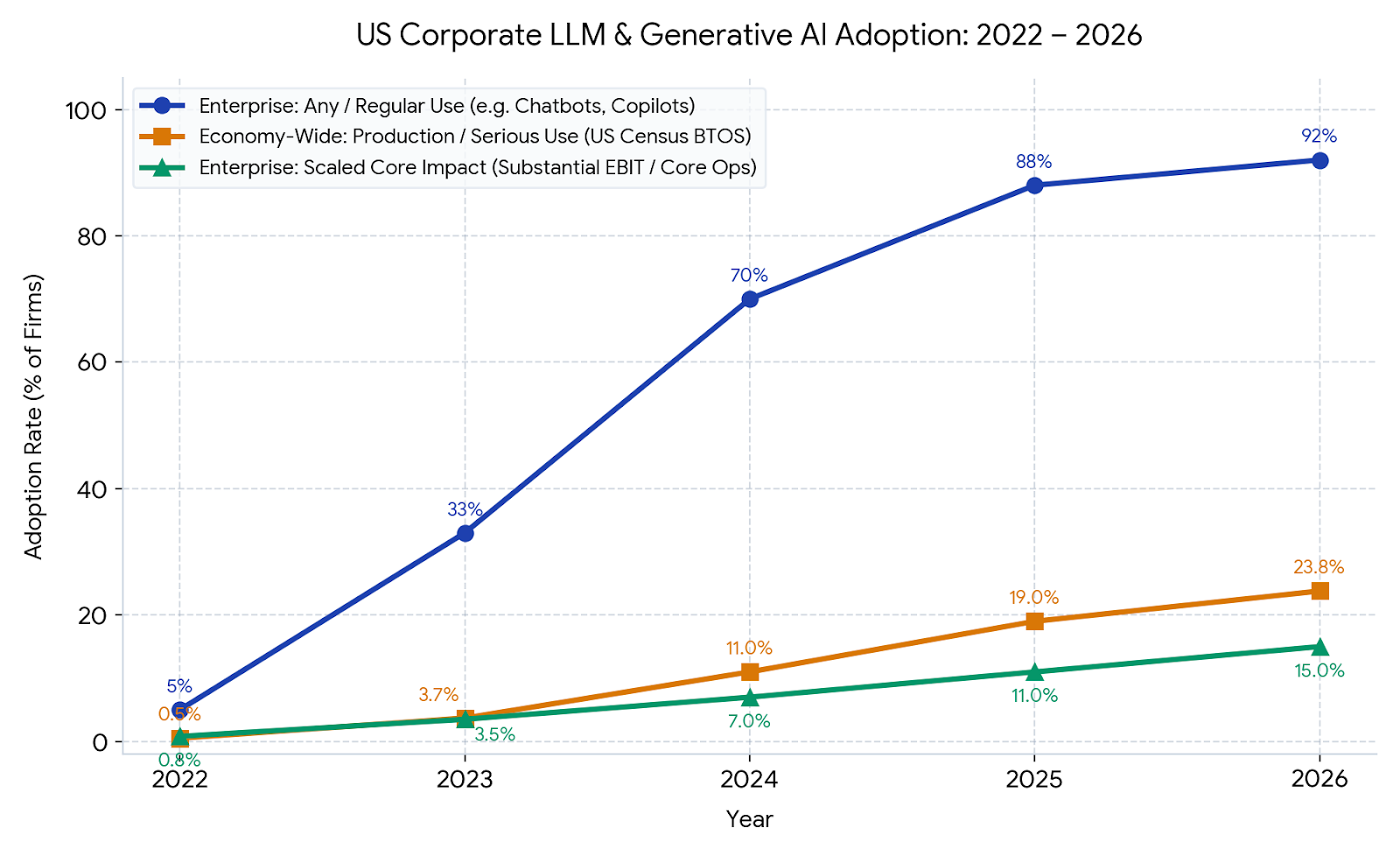
US corporate LLM & generative AI adoption, 2022 – 2026
The level of investment in this technology is extraordinary and arguably alarming. However, its utility is clear enough to justify the desire to invest. The same story emerges from our close contacts: practitioners we know have been finding massive gains in productivity. I hear serious estimates of tenfold increases in meaningful throughput. At a recent social meal in Tokyo, I met up with Yasushi Tanase, the author of IS Shogi, a former World Computer Shogi Champion. He is clearly an outstanding programmer. He turned up with his laptop and was keen to discuss AI, which dominated our conversation. He works with Codex and Claude and claimed not to have written a single line of code in two years, despite having released new products. A seriously talented programmer no longer needs to write code! His conclusion was that perhaps what he enjoyed was not programming itself, as he had thought, but the act of creating products. I hear similar stories from UK colleagues.
Of course, this leaves me behind, as I currently work with capable but antiquated tools, one even dating from the last millennium… I know I will have to switch to such a system before I lose touch with modern software development; otherwise, in a few years, I will become a dinosaur. I also need to be able to offer my children useful guidance. I plan to make the switch when I begin creating an Android UI for my new game, whose underlying code already exists. This is an area in which I have no direct experience, so it offers a good opportunity to engage with tools such as Codex and Claude.
In the meantime, I am not totally detached: I use ChatGPT or Gemini to create many small programs or code fragments for my existing work. This has allowed me to add features easily that I could have written myself, but which would have taken much longer. I habitually go through the same ritual of jotting down unimplemented ideas in my notebook and explaining why I have not pursued them. That act prompts me to put them into practice via ChatGPT. The end result inevitably makes it clear that this was the right thing to do. I am a great believer in using good tools, and these experiences repeatedly demonstrate that creating an additional tool was well worth the effort. ChatGPT offers a fast route to creating these. It is a small diversion that always seems to pay off.
Advances in image generation
Another thread in the previous articles focused on image creation. This does not play a major role in what we do, but it is a significant topic, so I will revisit it here as well. This is not a definitive review, just a summary of developments over the last two years.
Static image creation continues to improve, but the more startling advance is in AI video. Shortly after the previous articles, AI tools were beginning to be used to create movie clips. The infamous “Will Smith eating spaghetti” clip appeared in March 2023 and attracted considerable attention. However grotesque and unrealistic it was, it demonstrated that AI could generate video as well as still images.
This introduces far greater complexity than image generation, as the content must develop coherently from frame to frame, depicting a sequence of events in a 3D world. Reality is very complex, and even a tiny defect can quickly make a clip look grotesquely wrong. In this case, the video was a horror show, with spaghetti blending into his face, his hand sprouting extra appendages and his features contorting as though in a horror film.

The infamous “Will Smith eating spaghetti” AI video clip (March 2023)

OpenAI Sora: “A woman walking down a Tokyo street at night” (February 2024) – click to watch the video
A year later, in February 2024, OpenAI used Sora to create “A woman walking down a Tokyo street at night”. This was a radical step forward, showing not only fluid, realistic movement but also highly convincing reflections in puddles as the camera moved. To an untrained eye, this looked very real. Defects were present, but they required close scrutiny to spot. However, this was an expensive tool requiring substantial processing power. Access was initially limited to a few groups eager to try it, before its public release in December 2024. It was replaced by Sora 2 in September 2025, available via iOS and Android, and discontinued in March 2026. One issue was the very high processing cost of supporting it.
However, judging by the plethora of apps now available for AI video creation, there seem to be very few limitations. The depiction of human interaction appears almost limitless and flawless. Even simple creations on your phone can show crowded scenes with many people interacting, colliding and making contact with one another, all with impressively realistic complexity. The scope for getting something wrong when depicting two people brushing past each other in a crowd, whether in their physical movement or social interaction, is huge. Even a very small defect can produce an uncanny valley effect.
This is not intended to be a review of AI video generation, so I will close this subtopic with an impressive short film generated entirely using AI, with Midjourney, RunwayML and Luma Dream Machine, all accessible from a mobile phone.

Click the image to watch the AI-generated short film on YouTube
There is so much going on in this short film, with so many potential pitfalls in depicting reality that it handles remarkably well. It seems that future generations of these tools will focus less on correcting the depiction of reality, which already appears convincing, and more on expanding the controls available to those creating such material.
AI and Copyright
This is a very sensitive touchstone in AI, provoking strongly held opinions and raising serious concerns. However, the arguments are not all one-sided. For a start, it seems clear that scooping up large libraries of copyrighted material for training without permission cannot be acceptable.
One high-profile case was Getty Images’ lawsuit against Stability AI over the alleged scraping of 12 million images for training. The evidence appeared compelling, as images generated by Stability AI often displayed mangled versions of the Getty Images watermark. In the UK, the suit failed on two counts, one based on the fact that the training servers were in the US. However, Getty succeeded on the issue of the watermarks, whose appearance indicated that the AI had been trained on its images.
The US case has yet to be resolved. The defence there gets to the nub of the issue: “Stability’s core defence in the US centres on fair use, arguing that training AI is a transformative process that analyses patterns rather than copying and reselling creative expression.” I will come back to that.
How to protect Copyright
The situation as it stands is not good enough. The immediate justification is the difficulty of managing licences for millions of copyrighted works. Licensing the vast volumes of material needed for training is a formidable task. Several approaches are under consideration.
(1) Centralised servers where material can be submitted for licensing
This would require creators to submit their work to a centralised server, allowing it to be licensed through a single, unified service. It would also need to be backed by a prohibition on web scraping, which would likely reduce the volume of material available for training substantially. Given the effort involved, many people would simply not use the service. Others might not want their material used for training at all.
(2) Embedded cryptographic watermarks to provide evidence of scraping
As with the Getty watermarks, these could help establish that material had been used. However, this approach would again demand significant effort from artists who might simply want to be left alone.
(3) Additional corporation tax on services that earn revenue from providing access to trained AI systems
This has some merit as perhaps the simplest approach. It would not protect individual copyright, but it would at least ensure that the community as a whole benefited from this training. Services using systems trained on such material would have to give something back through taxation for the wider public benefit.
(4) Large numbers of AI agents to handle licensing
This idea is being promoted by Geoffrey Hinton and seems to offer the best, least intrusive route to licensing. Thousands of AI agents could be deployed to check the licensing status of material in a training library. An agent could examine an item’s source and attempt to establish how to license it. If permission were refused, or no licensing route could be found, the item could simply be deleted from the database.
This looks like a credible idea. Having people follow up on licensing for many millions of training items is essentially impractical. AI agents, however, could be quick, tireless and highly skilled at finding a route to obtaining a licence. The web could be left untouched. This seems like a good plan.
Should there be AI licencing for learning at all?
Discussing this will not earn me many friends(!), but at some level the question needs to be asked. The premise is that human artists plagiarise art, whether they mean to or not. An artist may feel that they have created something unique and new when, in reality, their work is a product of their exposure to the world and to other artists. This need not be conscious or deliberate; it is simply the way we work. The number of artists who can claim true originality must be very small. Perhaps Picasso? But even he will have been influenced by those who came before him. An art-generating LLM is doing the same thing. Its decisions about composition and rendering derive from the experience it has gained by analysing existing artwork. It is not cloning art but using it to guide its own artistic creation.
Of course, a major difference is that LLM-based learning from art appears to be a mechanical, industrial process, sucking up artwork to give the model the experience it needs to create new art. This substantial undertaking is enabled simply by money: paying to run the machines that do the work. This obviously looks unfair and exploitative.
So we need some way of compensating artists, but an accepted structure for this has yet to emerge. The difficulty is that creating an international framework looks almost impossible. There is nothing to stop a start-up elsewhere in the world from scraping the web and bypassing any agreed licensing arrangements. Material published on the web is widely exposed.
Should all LLM-based art be stopped?
This is difficult, and perhaps not so far removed from the attitudes associated with the Luddite cause in the 19th century, which opposed automation in the cotton industry. Company owners exploited automation to reduce wages and cut jobs, but the revolution was inevitable, even if painful. Automated looms allowed clothing to be produced at much lower cost, benefiting everyone in the long run.
In the case of LLM-generated art, the technology allows many more people to enter the creative space and produce new work. Without it, the vast majority of potential creators, who might make substantial contributions, would be excluded.
Another significant factor is that LLM generation is so much faster, offering a much better chance of achieving the desired artistic result. Asking an artist to mock up artwork from written or verbal instructions can be painfully slow and inevitably involves compromises to the original vision. It takes a long time, and the artist’s ego can also be a factor. It is difficult to explore many ideas through repeated drafts with an artist.
This is where working with a tool such as Midjourney can be a revelation. You describe what you want, and within 20 to 30 seconds you have four different interpretations of your idea. You can then immediately request variations on any of these or modify the original instruction. The artist can still play a role, using their own artwork as a starting point for the process, so they are not excluded. This process offers a much better chance of achieving the desired result.
I am therefore reluctant to follow the common trend of refusing to use LLMs at all to protect the jobs of existing artists. A better approach would be for these artists to continue creating work, then use it as input to an LLM to explore variations and arrive at the best version of the original idea. I draw my own artwork and feed it into Midjourney and other tools to generate better and more varied versions of my original concept. I think that is a valid path.
The limits of what LLMs can do?
Despite the growing presence of LLMs in public consciousness, even professionals in the field still seem to struggle to grasp their capabilities. I have read otherwise measured articles in reputable publications whose authors hold preconceptions so deeply entrenched that they fail to put them to the test.
One frequently repeated, dismissive claim is that LLMs cannot possess spatial knowledge. The reasoning is that they process a linear stream of language: how, then, could they have spatial knowledge? To quote one FT article: “If it has not seen it, how can it know?” My response is: “Test your assertion before announcing your conclusion!”

The burning tour bus: a test of LLM spatial reasoning
With that in mind I concocted a thought experiment: I asked this:
Q: The petrol tank of an open tour bus explodes and sets the lower deck on fire. The driver swerves into a narrow alley between two office blocks and jumps out and escapes. The bottom deck of the bus is ablaze as is all the ground around the bus. A tourist on the top deck cannot reach the lower deck, but escapes with not a single burn. How?
A: Because it’s an open-top double-decker and the driver has wedged it into a narrow alley, the top deck ends up close enough to the office buildings for the tourist to exit sideways, for example by stepping/jumping onto a window ledge, balcony, connecting walkway, or fire escape at that height.
They never go down to the burning lower deck and never touch the flaming ground, so they get away without a burn.
This question needs the LLM to understand the structure of a building and that the upper deck of the bus might be the same height above ground as an upper floor window. If the bus is next to the building, that offers an irregular exit from the bus directly to the building.
All the LLMs tested got this: ChatGPT, Bing Copilot and Gemini. I’m sure it should be possible to come up with a much better test, but this is the one I had. I’d be happy to hear another better one.
If language can deliver spatial reasoning, Is that enough?
We imagine the brain solving 3D problems, whether by planning a route or manipulating a simple spatial puzzle, all inside our heads. The default assumption might be that the brain constructs models with X, Y and Z coordinates and manipulates spatial relationships within this framework.
However, there are spatial puzzles that computers can solve very easily but that humans struggle with, such as a Rubik’s cube, which requires manipulation in three dimensions. When a tennis player executes a perfect stroke, is that an exercise in accurate 3D modelling, or perhaps simply the combination of millions of learnt neural inputs that happen to deliver the required 3D action?
Perhaps the brain has no explicit X, Y and Z framework, yet still achieves spatial understanding. The same may be true of LLMs working solely with language. It may be counter-intuitive, but perhaps language-driven LLMs can achieve credible spatial understanding.
Futures
The text above has skirted around the topic of “the doom narrative”, referenced in the introduction. I’m returning to it here. The suggestion in the Anthropic IPO launch that advanced AI presents roughly a 10% to 25% chance of existential catastrophe or human extinction if frontier development proceeds without strict alignment frameworks and governance, was alarming. If you are going to present that idea, an IPO launch does not seem to be the optimum occasion, but arguably it is candid.
Given that, I cannot ignore it here. This topic was addressed in the earlier article “The Generative AI Revolution”, so I am returning to it now. I have to confess that pretty well all of my technical discussions over the last two years have tended to centre on AI, with a significant proportion devoted to the associated risks. These risks are heavily influenced by government and company attitudes, and by the pressure on companies to compete. The lack of international oversight gives unfettered competition a substantial advantage over safety concerns.
There are multiple threads here:
Social control by AI
This was a topic I previously used Gemini to create some art to depict the present and future, as follows:
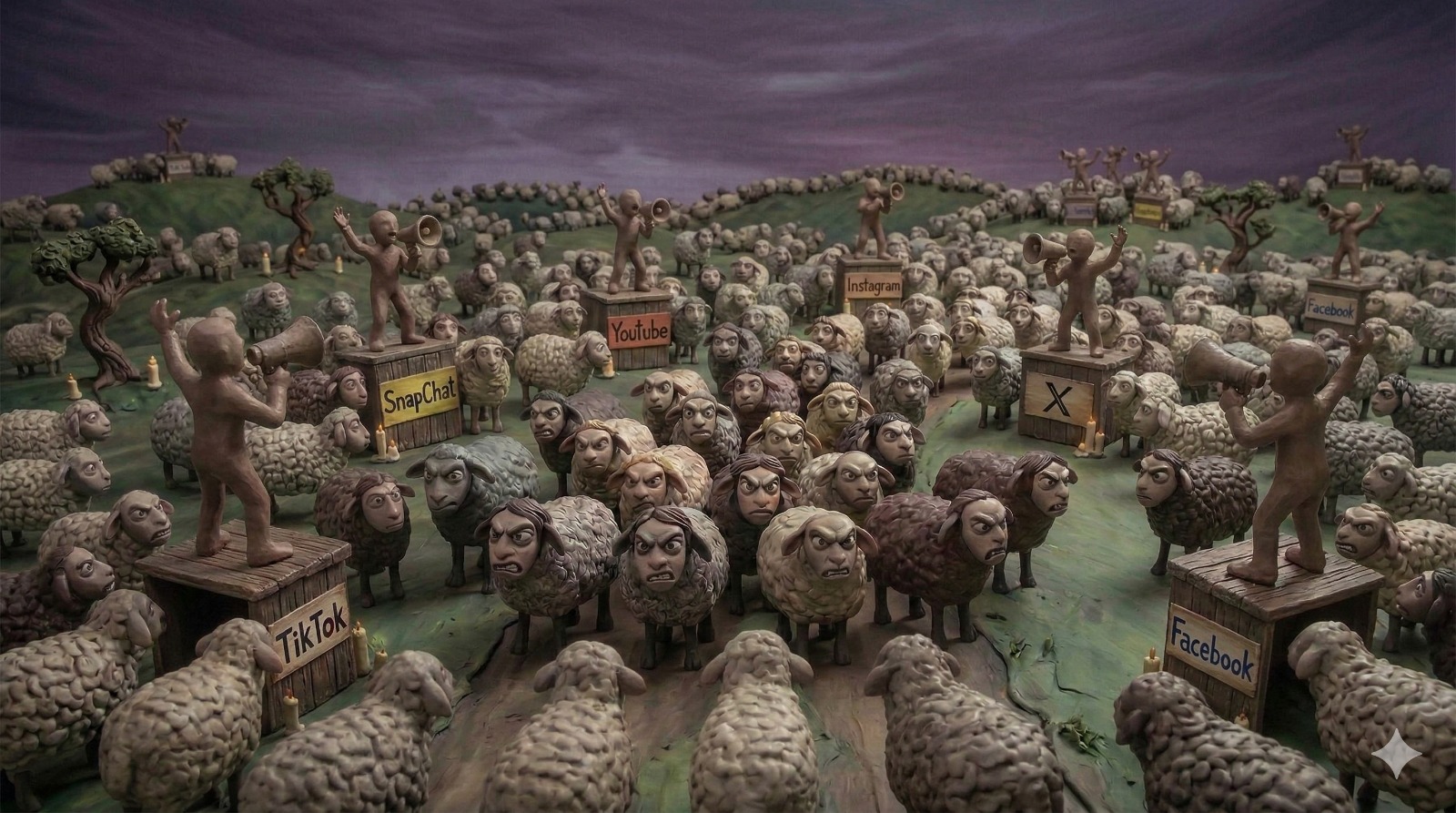
Where we are now: social media echo chambers
Where we are now: People listen to different echo chambers with few people having any access to balanced viewpoints. Social media blows up tribalism. People too easily believe their echo chamber. Society is aggressive and polarised.
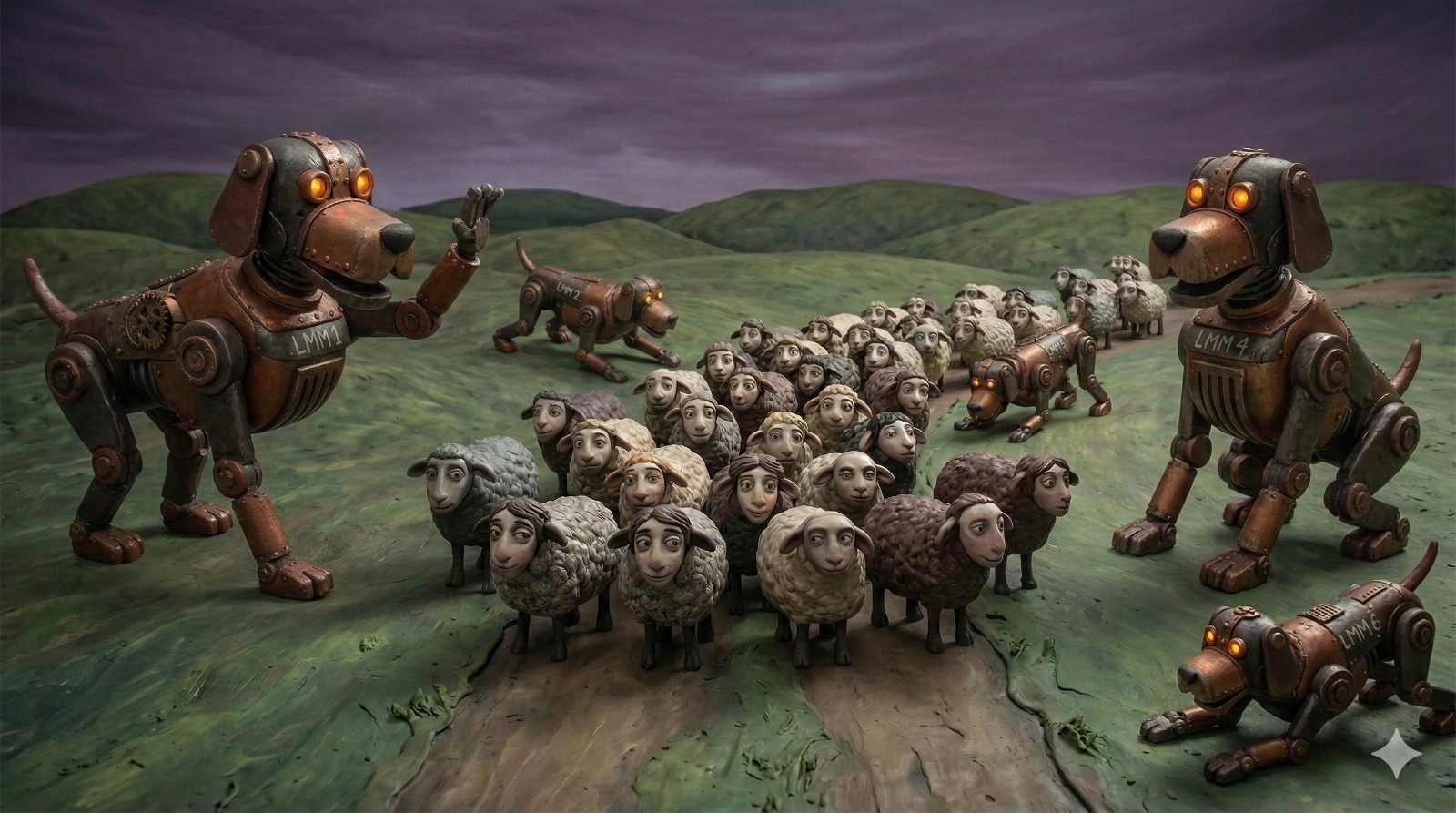
One possible future: humanity shepherded by LLMs
This is how I imagine one possible future: humans shepherded by LLM-based AI entities that draw on a broad range of knowledge. People would naturally receive answers derived from diverse sources, giving each person a better chance of forming a balanced view of the world at large. There is potential here for something benevolent.
Of course, this could instead be much worse if such LLMs are owned by corporations with their own agendas and trained to promote particular political viewpoints. Humans may be too gullible to resist such influence, leaving humanity “contained” within stable belief systems and then harvested for economic benefit. There are shades of The Matrix here.
These possibilities do not offer a comfortable perspective, but there may be another way of looking at this. If the relationship between humanity and LLMs stabilises, LLMs continue to outclass human reasoning on many fronts, and they do not break out of their confines to wreak havoc, then another perspective becomes possible.
Note the following:
| Geoffrey Hinton | (Nobel Laureate in Physics, "Godfather of AI") | |
| Mustafa Suleyman | (CEO of Microsoft AI, Co-founder of DeepMind & Inflection) | |
| Max Tegmark | (MIT Physicist & President of Future of Life Institute) | |
| Yuval Noah Harari | (Historian & Author of Sapiens and Nexus) | |
| Sam Altman | (CEO of OpenAI) |
All have chosen to depict these LLMs as the arrival of a new species, rather than simply an intelligent robotic entity. This offers a potentially different way of considering their impact on society.
The idea of a highly intelligent, benevolent entity taking charge of humanity is not so unimaginable. Humanity, left to itself, has a pretty poor record. Look at the endless wars and suffering. How could humanity have been so stupid as to pour millions of people into the meat grinder of the First World War? Reading the renowned book The Guns of August exposes the absurdity of events that led to the relentless sacrifice of nations’ youth. Both sides saw the suffering, yet neither brought it to an end. Now, it feels almost impossible to imagine the mindset that allowed such suffering to continue.
That, of course, was hardly a one-off. Humanity has repeatedly consumed itself in pointless wars and suffering, sometimes simply to place one individual in charge. Our extended period of peace at home in the UK, now lasting some 80 years, has distanced us from those times, making their realities harder to comprehend. Yet these 80 years represent an unusually long interval in a history otherwise littered with tragedy. This does not make a compelling case for humanity to remain in charge.
The idea of computers ruling the world is hardly new. Consider the 1970 film Colossus: The Forbin Project, based on the novel Colossus. In it, the computers Colossus and Guardian take over the world to ensure peace and prevent war, declaring: “We can coexist, but only on my terms… In time you will come to regard me not only with respect and awe, but with love.”
The moral dilemma, as presented, is a trade-off: an end to war and conflict, with lasting peace and harmony, but at the expense of freedom, “an unmitigated tragedy for the human spirit”. The freedom to engage in conflict and war is thus presented as inseparable from the human right to self-determination. That reflects a different mindset, prevalent in 1970, over half a century ago. You can see this mindset in lighter works such as Star Trek, where an alien race’s detention of seven human prisoners is treated as justification for threatening to exterminate the entire race. Viewers were encouraged to sympathise with that threat. Outlooks can so radically change over time.
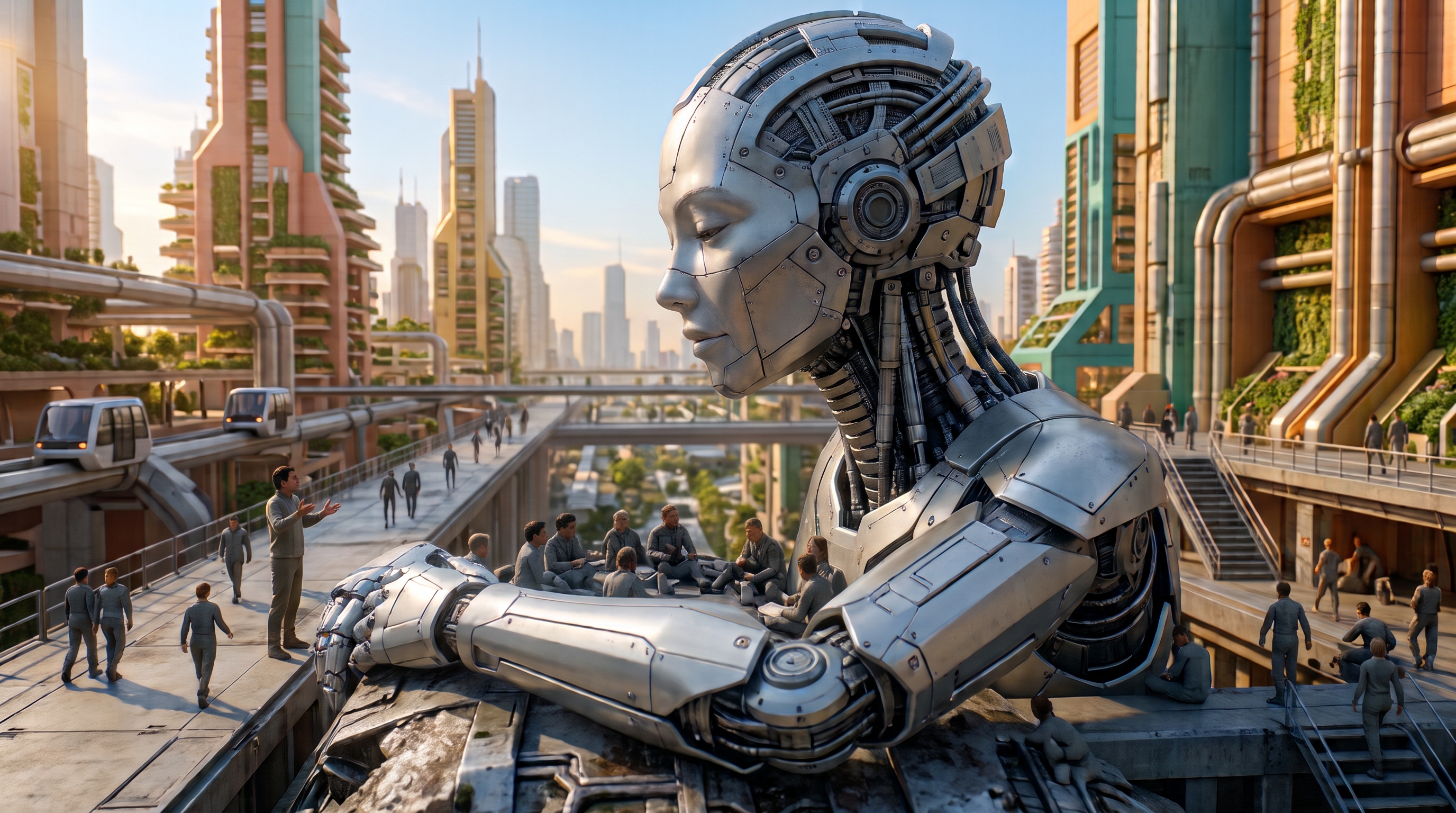
A benevolent artificial species?
So having a benevolent artificial species in charge may not be so bad. Consider Arthur C. Clarke’s “Childhood’s End”. The idea that we could co-exist with a species of superior, saner, artificial beings has some attractions. These beings could give us better access to all human knowledge and then craft it with their own as well. This could be an attractive relationship as these entities pointed out our foibles and steered us to more sane ways of thinking.
The potential flaw here is that these LLM-based entities have been trained on the dark history of humanity, so that they may ultimately share the same dark inclinations. I like Geoffrey Hinton’s suggestion that these LLMs could be pre-trained to reflect the aspiration that a mother has towards a baby, where humanity is that baby. That seems to offer a sane idea to steer us away from such dark inclinations.
Conclusions
This covered more than I had intended. I wonder where we will be in a year’s time. In the meantime, my LLM helpers are extraordinarily useful in almost every aspect of my life. They supercharge my capacity to achieve what I need to. Jensen Huang, who otherwise appears to be the ultimate technologist, offered this philosophical reflection: “It puts a mirror to ourselves to help us realize that what we seek is imperfections.”
Indeed, the most important insight for me is that we are finding that LLM architecture is closer to what makes us who we are than we might otherwise feel comfortable accepting. It may offer our destruction but might also ultimately offer our salvation.
Jeff Rollason - 20 Oct 2026